
Developer tools database schemas
Repositories, pipelines and events. These schemas are append-heavy: a run, a deploy and an error are facts that happened, so they are written once and never edited. Every one opens in the free drawDB editor in a click, and is public domain.
8 schemas here, from 11 to 14 tables (100 tables and 840 columns in total), written for PostgreSQL. Each one ships an ER diagram you can open and edit, a column-by-column reference, design notes explaining the trade-offs, and SQL for all six dialects.
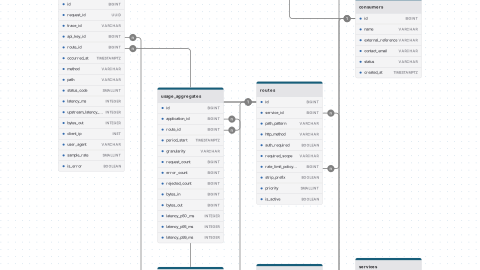

API gateway & rate limiting database schema
How an API platform is modelled: consumers and applications, hashed API keys with scopes and rotation, upstream services and routes, rate limit policies, durable usage counters, rolled-up aggregates, sampled request logs, plans, quotas and overage billing.
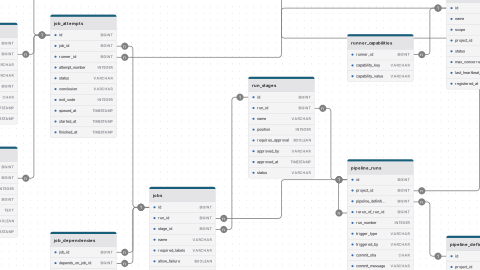
CI/CD build pipeline database schema
How a build system models its data: versioned pipeline definitions, immutable runs triggered by a commit, stages with approval gates, a job DAG stored as edges, runners and capabilities, attempts and retries, artifacts, caches and streamed logs.
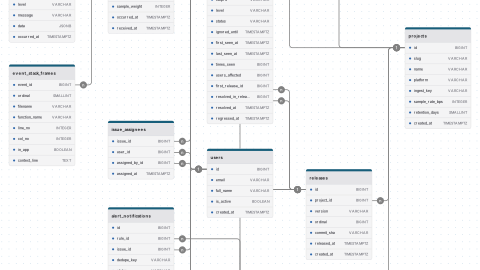
Error tracking and monitoring database schema
How an error monitoring service models its data: projects and releases, raw events with stack frames and breadcrumbs, grouping into issues by fingerprint, resolve and regression detection, alert rules and event sampling.
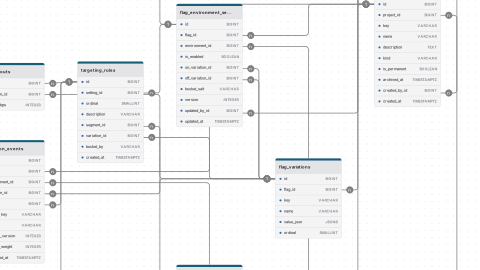
Feature flag service database schema
How a feature management platform stores its data: flags and variations, per-environment settings, ordered targeting rules, reusable segments, percentage rollouts with deterministic bucketing, scheduled changes and a full audit trail.
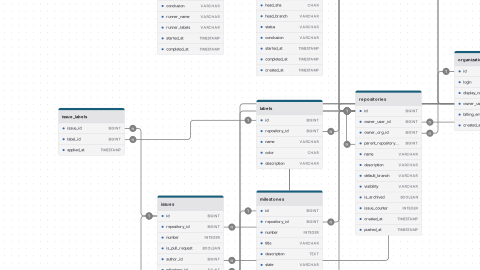
GitHub code hosting database schema
How a code hosting platform models its data: users and organisations, repositories, refs and commits, issues and pull requests sharing one number sequence, reviews with comments anchored to a file and line, labels, milestones and workflow runs.
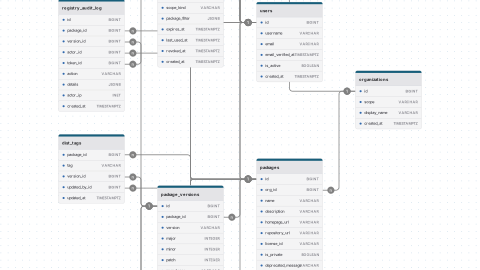
Package registry database schema
How a package manager backend stores its data: packages and immutable published versions, integrity hashes, dependency ranges, movable dist tags like latest and beta, owners and scoped access tokens, download rollups, deprecations and yanks.
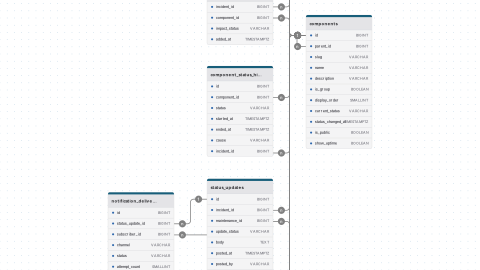
Status page & incident communication database schema
How a public status page is modelled: a component hierarchy with status history, incidents and severities, the timestamped public timeline, scheduled maintenance windows, email and webhook subscribers with delivery tracking, uptime samples, computed uptime and postmortems.
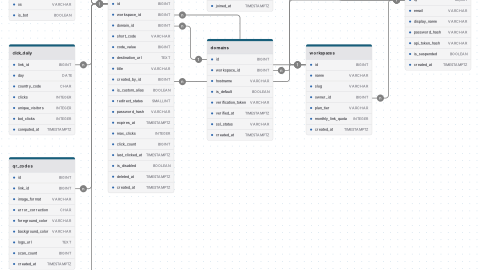
URL shortener & link analytics database schema
The classic system-design question, modelled properly: short codes from a base62 counter, custom aliases and custom domains, an append-only click log with daily rollups, expiry and click limits, QR codes and blocked-domain safety checks.